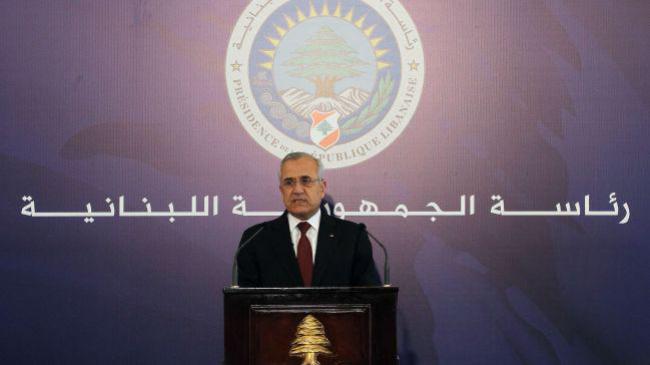
Lebanese President Michel Sleiman has spent his final day in office, leaving behind a power vacuum in the country as the parliament failed to pick his successor after five attempts, Press TV reports.
While bidding farewell to the presidential palace on Saturday, Sleiman said the power vacuum may have been caused intentionally by certain Lebanese factions.
He urged the country’s politicians to choose a successor for him, warning that a presidential vacuum threatens “the political order” in the country.
“I urge the legislators to elect the new head of state without any further delay,” Sleiman added.
The deadlock is linked to the political polarization between March 14 Alliance, on the one side, and Hezbollah and its allies in the March 8 Alliance, on the other.
March 14 Alliance, which is led by the pro-Saudi figure Saad Hariri, has thus far supported the candidacy of anti-Hezbollah figure, Samir Geagea, who is well known for having a history of collaboration with Israel.
Hezbollah hence accuses March 14 Alliance of stalling the process by backing such candidate.
Meanwhile, Saudi Arabia’s Foreign Minister Saud Al-Faisal has reportedly objected to the candidacy of Hezbollah ally, Michel Aoun, a former Lebanese army commander and the current leader of the Free Patriotic Movement.
Aoun’s recent efforts to reach an understanding with Hariri on dividing power within the country have failed.
After Sleiman’s departure, the national unity government will administer the country until a new president is selected. In Lebanon’s power-sharing system, the president must be a Christian, the prime minister a Sunni Muslim and the parliament speaker a Shia Muslim. Any presidential candidate would have to receive the backing of the two main political blocs, March 8 Alliance and the rival March 14 Alliance, to win the necessary majority from the legislature’s 128 members.
Lebanon went for months without a president before Sleiman, a former army commander, was elected in 2008.